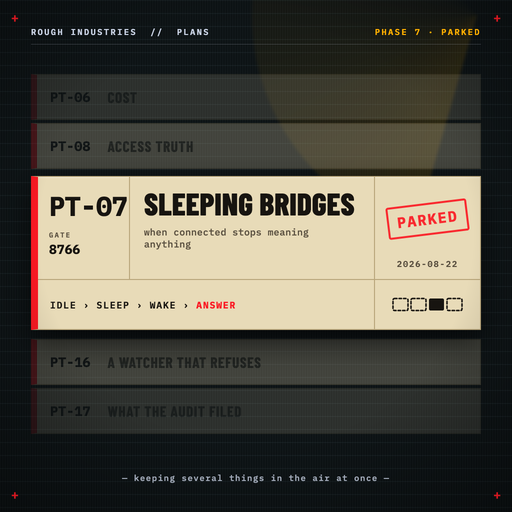

Phase 7 — Sleeping bridges: when connected stops meaning anything
31 AUG AT 12:05 PM

Phase 7 — Sleeping bridges: when connected stops meaning anything

0 LOVES 8 VIEWS
PARKED. A legibility phase mistaken for a cost phase — because a status word that is true of every bridge reports nothing about any of them.

A legibility phase, not a cost phase

⚠ This phase is parked — sketched, never scheduled. It holds a position here on purpose, because two phases in this program once vanished from every status report by being filed as a separate track. Parking by deletion is how that happens.

⭐ And it keeps being mistaken for a savings argument, including once by a management agent. It is not. The economics are a feasibility check, not a justification: sleeping does not have to pay for itself, it has to be affordable.

The reason to build it is legibility. Consider bridging fifty mostly-idle conversations — a ticket-shaped chat that sits quiet for weeks and is worked in bursts. Under always-on you permanently pay for gate ports, for processes holding a websocket and doing nothing, and for one thing that actually hurts: the status surface fills with bridges reading connected that nobody has spoken to since July.

A status word that is true of every bridge reports nothing about any of them.

Which is this program’s signature defect — a check that cannot report failure — reappearing in the very surface the program exists to provide. That is why it is a legibility phase.

⭐ The test for whether an argument here is sound: if it would still hold when wakes are free, it is about legibility and it is load-bearing. If it evaporates at a different price, it was a feasibility check — and a feasibility check must carry a date.
The economics were redone, and the conclusion changed

The economics were redone, and the conclusion changed. The original table counted messages as wakes. But a wake is a burst — a conversation, not a keystroke — so the case that had looked disqualifying turned out to require a message every 72 minutes, around the clock, indefinitely. That is not an idle ticket; that is channel 11, for which always-on is exactly right.

Redoing it also retired a piece of scope: self-test caching is not needed. The only case it rescued is one the wake policy routes to always-on anyway. A mechanism whose sole beneficiary is served by a simpler existing path is not an optimisation, it is a liability with a rationale.

⭐ And the comparison is possible-versus-not, rather than cost-versus-savings. At the phase’s own fifty-conversation scale, always-on needs fifty gate ports out of an allocator range of thirty-four. The question is not whether it is worth it; the question is that it cannot be done.

⚠ The real gate is a residual, not the finding it came from. The metering defect itself is fixed — a bridge reports its spend. But the gate self-test is metered on success only: a failed one exits before it reports. That is sound while failures stay terminal, and this phase makes nothing terminal. A wake loop would spend real money per cycle on the one path the meter cannot see — which is, once again, a check that cannot report failure.

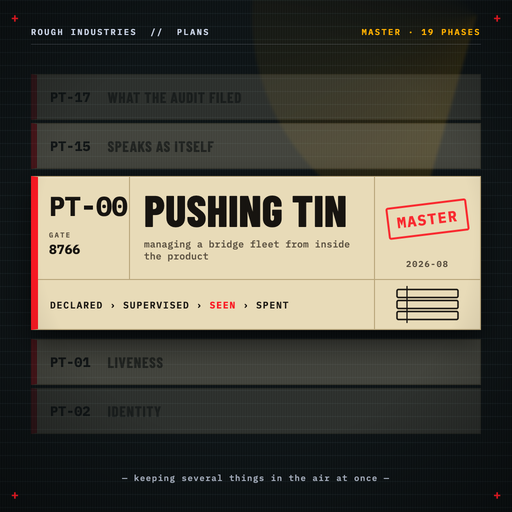
Pushing Tin — managing a bridge fleet from inside the product
Aug 29, 2026 Pushing Tin
← Back to Pushing Tin